


The 1998 Higher School Certificate (HSC) Media Guide
Contents
1998 Higher School Certificate Statistics and Story Leads
The Higher School Certificate: breaking records
This year a record 65,667* students around the world will sit for the New South Wales Higher School Certificate examinations -- an increase of 2,629 on last year's figure of 63,038. The first HSC examination took place in 1967 and since then more than one million people have been awarded this internationally recognised credential. Higher School Certificate Entries 1988 to 1998
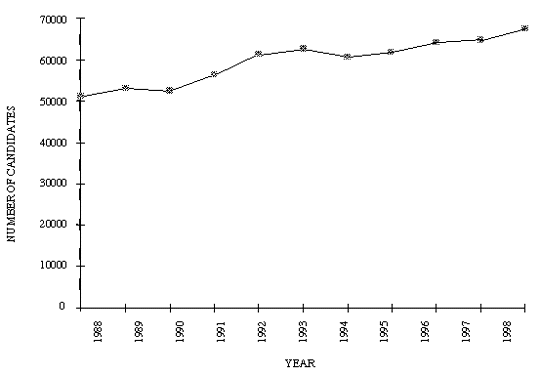
Please note: All statistics in this guide refer to the enrolled
candidature of 1 September 1998.
Over the years the HSC has changed and developed to meet the needs
of NSW students. This year will see the introduction of the Universities
Admission Index (UAI), replacing the Tertiary Entrance Rank (TER).
The UAI ranks students in relation to other HSC students for tertiary
entrance purposes on a scale of 0-100
1998's HSC offers 75** subjects organised into 165 courses.
Distinction Courses -- high-level courses offered through universities
by distance education -- were undertaken by 76 students in 1998.
Distinction courses were introduced in 1994. Three courses are available:
Comparative Literature, Cosmology and Philosophy.
The change in the student demographic has also led to an increase
in the number of students choosing vocational educational courses,
with 4,931 students choosing to study such courses in 1998.
The introduction of the Pathways program in 1993 enabled students
to take a more flexible approach to their HSC studies, giving Year
12 students up to five years to complete their HSC courses. This
year 6,771 Year 12 students chose to use the Pathways model (see
page 15) in pursuing the Higher School Certificate.
The class of '98
-
65,667 students are enrolled as HSC candidates this year.
-
The subjects with the largest candidatures are English, Mathematics, General Studies, Biology, Business Studies and Computing Studies (in descending order), while the subjects with the smallest candidatures are Lithuanian, Estonian, Slovenian, Latvian, Hungarian, Dutch and Czech (in ascending order).
HSC postcards from across the world
-
Three students are doing the HSC on Royal Australian Navy ships: a female student on HMASMermaid based in Cairns, a male student on HMASTorrens based in Rockingham, WA and another male student currently sailing from California to WA.
-
There is one male student, a soldier, sitting the examination at the Alice Springs Army Base.
-
There are 200 overseas students sitting the HSC in 1998. Most are Australian exchange students studying overseas, while some are nationals from other countries where there are Board-recognised independent schools providing the NSW HSC.
-
Other students sitting the HSC overseas include: a student taking her HSC examination on the Ivory Coast in West Africa, where her parents are missionaries; a Dubbo High School student sitting the HSC in New Mexico USA where he is on a basketball scholarship; a student studying at the National Ballet School in London who will sit the NSW HSC examinations in England; another who will sit the examination in Harare in Zimbabwe; a student in Saudi Arabia; and one student in the USA who will be taking her Russian Oral examination by telephone.
-
Over 40 students who had previously been studying in Australia are doing the HSC examinations in Japan in order to be available for the Japanese University Entrance Examinations, which are timetabled around the same time as the HSC examinations in NSW.
Five students are doing HSC examinations in South Korea so they can also sit the South Korean University Entrance Examination, which have similar timetabling requirements.
Most of these students are Japanese and South Korean nationals who have been studying in NSW while their parents have been posted to Australia. The students are returning to Japan and South Korea to study at university.
-
There are also students sitting for the HSC in the Sultanate of Oman, the United Arab Emirates, Pakistan, Turkey, Vanuatu, USA, Indonesia, the Czech Republic, Germany, England, Canada, Uruguay, Papua New Guinea and Fiji.
** Each Science course is treated as a separate subject; all three Distinction Courses are treated as one subject.
The HSC for young and old
-
There is an 11-year-old student from Kingswood doing the HSC in Contemporary English, 2 Unit Mathematics and 2 Unit Physics.
-
A 13-year-old from Raby is doing 2 Unit Chemistry, 2 Unit Physics, 2 Unit Economics and 3 Unit Economics.
-
There are also three 14 year olds doing HSC subjects: a girl and boy, both doing 2 Unit Music (AMEB)and both from the far north coast of NSW; and a boy from south-western NSW doing 2 and 3 Unit Mathematics.
-
The oldest HSC candidate this year is an 83-year-old student from Sydney's North Shore who is studying 2 Unit Legal Studies.
-
There are two 76-year-old students -- one from far-west NSW doing 2 Unit Rural Studies through TAFE and another from the Central Coast doing 2 Unit Mathematics and 1 Unit General Studies.
Please contact the Media and Public Relations Branch on (02) 9367
8250 if you would like more information regarding these students.
Exams in all shapes and sizes
-
Four students sitting the HSC this year will have specially produced braille examination papers. The papers are an equivalent transcription of the standard examination papers but use a variety of techniques, including diagrams that are formed by using dry spaghetti, to make the raised lines and angles needed.
-
Twenty-nine students sitting this year's HSC will have examination papers that are printed in colours different from the standard papers. These papers have been specially designed to enable students to read the examination questions easily, as some students find it difficult to read text printed on paper of a certain colour.
-
There will be approximately 420 large-print examination papers produced for students with visual impairment. The papers' type size ranges from 18pt to 36pt and most of them are printed on A3-sized paper.
-
Approximately 15 hearing-impaired or deaf students sitting the listening paper examination in Contemporary English -- which is aimed at testing student comprehension -- will watch an AUSLAN, signed English or subtitled video instead of listening to the usual audio tape.
The HSC in languages
There are 38 languages on offer in the 1998 HSC. Languages are studied
in both government and non-government schools, TAFE, and through
approved outside tutors.
Many languages are studied through the Saturday School of Community
Languages, which had 1,494 students enrolled this year, or the Open
High School and other Distance Education Centres run by the Department
of Education and Training.
Japanese is the most popular language, although languages that have
been popular in the past, such as French, German and Italian, continue
to have appeal. The most recent languages introduced to the HSC
are Hindi, Persian, Portuguese and, in 1998, Filipino (Tagalog).
In 1979 there were only 56 students studying Japanese in New South
Wales: this year there are nearly 1,700 students studying the language.
Twenty-seven languages are supported under the National Assessment
Framework for Languages at Senior Secondary Level (NAFLaSSL). All
are developed according to a common structure emphasising the ability
to communicate in varied contexts, flexibility to accommodate all
students in all areas of Australia, and emphasis on cultural awareness.
Release of HSC results information to the media
The Board of Studies will provide the media with the HSC Course
Merit List -- a list that details the students who have achieved
a mark of 90% or more for each course. This mark is a composite
of both the examination mark and the moderated school assessment
mark.
The Board of Studies does not have access to students' UAI information
from the Universities Admissions Centre. As recommended in the NSW
Government's White Paper, Securing Their Future, individual results
are confidential and will not be provided to parties other than
the student, the Universities Admissions Centre and the universities
to which the student has applied.
Technology: interfacing students, teachers and the HSC
HSC results available on the Internet
For the first time, students will be able to access their HSC results
over the Internet. Taking advantage of the latest technology, the
Board of Studies will establish a special HSC results web page on
its Internet site. By using their student number and their personal
identification number (PIN), students will be able to read their
HSC results information on screen. The PIN, which will be the same
for both the HSC results web page and the HSC results phone line,
will ensure the security of the information.
Students will be able to access their results on the Internet from
6 am Saturday, 2 January 1998, coinciding with the start of the
HSC results phone line.
There will be no additional cost to those students who use this
service, beyond the charges applied to their Internet Service Provider
and/or the cost of the call.
The new service is just one of the ways the Board of Studies is
using technology to deliver the HSC results to students faster,
giving them more time to consider their future options.
HSC results web page: http://www.boardofstudies.nsw.edu.au
Release of results by telephone
New South Wales students are able to access their 1998 HSC results
three days before they will arrive by post, by using an automated
telephone service.
From 6 am on Saturday, 2 January 1999 until the end of January 1999,
students can ring 1902 220 100, key in their student number and
Personal Identification Number (PIN) and get their results by recorded
message. The students' PINs will be sent to them in mid-November
in a letter from the Board of Studies.
The service will run 24 hours a day and it is estimated that each
call will take approximately two minutes, although students will
have the option of having their results repeated.
Students will still receive their results by mail, through Australia
Post, on 5 January 1999.
The Board of Studies established the phone service last year to
give students as much time as possible to make decisions concerning
tertiary studies and employment choices.
The Board will also run an HSC Inquiry Centre to support the phone
service. The centre will run from Saturday, 2 January, 1999.
HSC results by telephone number: 1902 220 100
Since the Board of Studies launched its website on the World Wide
Web in September 1995, the site has opened direct communication
channels for 100,000 teachers and one million students. The website
has had more than 400,000 `hits' per month. This is an extraordinarily
high rate for an Australian non-entertainment site.
Most of the hits were from Australia, with the bulk of the remainder
being from the US, Singapore, New Zealand, Canada, UK, Japan, Malaysia,
Spain, South Africa, Sweden, Germany, The Netherlands, Thailand,
Hong Kong, and Indonesia (in descending order). With more and more
schools accessing the Internet, students and teachers can link up
to the Board's site to find out important information relating to
syllabuses, the School Certificate, the Higher School Certificate
and Board publications.
Students doing the Higher School Certificate are able to access
a calendar of important dates leading up to the examinations, as
well as the Higher School Certificate examination timetable.
Students and teachers are also able to access Board of Studies publications
such as Board Bulletin, which offers important news and updates
about Board requirements; On Board, a magazine for students in Years
10, 11 and 12 that is written and designed by students in Years
10, 11 and 12; and `Primary Matters', a monthly column for K-6 teachers;
plus past HSC examination papers and HSC examination reports.
The average visitor to the Board website views 7 pages. In the months
following the launch of the English K-6 Syllabus in April 1998,
more than 800 copies a week were being downloaded by parents, teachers
and the interested public.
In the week beginning 7 September 1998, users downloaded 1506 copies
of the Computing Studies Glossary of Terms (2nd edn) and 877 copies
of the 1997 HSC 2 Unit English paper 1. Other documents were similarly
popular. Many copies of the specimen School Certificate papers were
viewed, as were the complete collection of School Certificate and
HSC review materials such as press releases, newsletters and reports.
The site offers a sample of Board products, including access to
extracts from some of the educational CD-ROMs produced by the Board
of Studies. About 40 e-mails a day are received on the Board website
with orders for Board products, enquiries about the availability
of particular documents and requests for general information. These
are directed to the appropriate Board officer for attention. The
Board of Studies updates its site daily, adding new announcements,
syllabuses and support documents and other useful information.The
processes for the web publication of documents have been upgraded
so that now the document may appear on the website within hours
of it being authorised for publication.
A list of links to schools throughout Australia is maintained, as
are lists of links to subject-related websites across the world.
Accessing the Board of Studies website
68% of the users come to the website from their own bookmarking
of the Board's website.
14% come to the website from key-word searches in a search engine.
13% come to the website through the Board's linking with the Charles
Sturt University HSC On-line website.
5% come to the website through the hundreds of other link pages
where the Board site is listed (such as the Macquarie University
Library Links Pages).
The website address is http://www.boardofstudies.nsw.edu.au
The HSC On-line website helps students sitting for the HSC by giving
them access to a wealth of HSC resources and support, no matter
where they live in New South Wales.
The New South Wales Minister for Education and Training, John Aquilina,
commented: `In this most important of exams, I'm glad to see that
through technological innovations we are able to provide students
with equity of access to information and resources no matter where
in the state, or indeed in the world, they might be studying for
the NSW HSC.'
HSC On-line's materials have been developed by highly experienced
HSC teachers and examiners, and many of the site's resources have
been drawn from the best available world-wide resources.
The site includes a newsgroup to enable students to exchange ideas
and practices as well as information about career and further study
options. It also has links to school websites in New South Wales
and around Australia.
The following subjects are covered by the site: Aboriginal Studies,
Agriculture, Ancient History, Computing Studies, Cosmology, Drama,
English, Geography, Japanese, Mathematics, Modern History, Biology,
Business Studies, Chemistry, Design and Technology, French, Music,
PDHPE, Society and Culture, Studies of Religion and Visual Arts.
Other subjects, such as Dance, Economics, Food Technology, German,
Hospitality, Indonesian, Legal Studies and Physics, will be covered
by the site in the near future.
Mr Aquilina said: `Given our government's strong emphasis on the
importance of technology education, students' ability to use their
technical skills to enhance learning and secure better employment
and further education opportunities is completely in step with our
goals to provide avenues for young people to move into the 21st
century.'
The HSC On-line project is a joint venture between the Department
of Education and Training and Charles Sturt University. It is supported
by the Board of Studies NSW and the Joint Council of NSW Professional
Teachers Associations and is sponsored by Access Australia.
The CD-ROM contains Higher School Certificate examination papers
and selected examination reports from 1995, 1996 and 1997. Schools
are provided with all the HSC examination papers on CD-ROM using
Adobe Acrobat software (except those languages with non-Romanic
scripts, subjects with small candidatures or music or language tapes).
Acrobat allows access across Macintosh and Windows computers and
is provided to schools at no charge. This initiative was developed
in 1996 in response to schools' requests to provide past papers
early in the new year.
Schools have responded very positively to the HSC Examination CD-ROM
and as a result the 1998 examination papers will also be provided
on CD-ROM.
The HSC Advice Line first opened in October 1995 to offer HSC students
last-minute advice and information from highly qualified teachers,
prior to the examinations.
In its first year of operation, 23,849 students called the HSC Advice
Line. Last year 39,150 students called. Calls were approximately
nine minutes in duration. It has received very positive feedback
from students since its inception.
The Advice Line is designed to give support and advice to students
at times when students cannot access their own teachers -- on weekends
and after school hours throughout the examination period. It opens
on Monday 12 October 1998, two weeks before the examinations begin,
and concludes on Monday 23 November.
No matter where a student is calling from in New South Wales, the
cost is that of a local call.
The phone-in service is staffed by more than 750 teachers who are
chosen on the basis of their experience and expertise in their subject
areas.
The service will offer advice for the following large candidature
subjects:
|
Ancient History (2/3) |
Geology |
|
Biology |
Legal Studies (2/3) |
|
Business Studies (2/3) |
Mathematics (all courses) |
|
Chemistry |
Modern History (all courses) |
|
Computing Studies (2/3) |
PDHPE |
|
Economics (2/3) |
Physics |
|
English (all courses) |
Science (all courses) |
|
General Studies |
Studies of Religion |
|
Geography (2/3) |
Visual Arts (2/3) |
The Advice Line will operate up until, and including, the night
prior to the final examinations in each of the above subjects.
The hours of operation will be Monday to Friday 4 pm-10 pm, Saturday
10 am-6 pm and Sunday 10 am-10 pm. The Advice Line telephone
number is 13 11 12.
Students with hearing difficulties
Students with hearing difficulties have access to the HSC Advice
Line through a teletypewriter facility. Students wishing to use
this facility are encouraged to make initial contact with the Advice
Line operators through family and friends.
HSC Examination Inquiry Centre
The Board of Studies will run an Inquiry Centre to support the
release of the HSC Examination Results.
This year students will be able to get their results by phone or
on the Internet from Saturday, 2 January 1999, as well as by post
on Tuesday, 5 January 1999 (see page 11). The HSC Examination Inquiry
Centre will open from 9 am on Saturday, 2 January 1999. It will
be staffed by Board Liaison Officers, Board of Studies officers
and personnel from government and non-government schools.
The HSC Examination Inquiry Centre provides an opportunity for students
to discuss any queries regarding their Higher School Certificate
results.
Personnel at the HSC Examination Inquiry Centre are able to answer
questions by telephone about results only. Inquiries relating to
university admissions and post-secondary education should be directed
to the Universities Admissions Centre or the Advisory Centres for
Students and School Leavers.
Inquiry Centre Phone: 13 11 12
A more flexible Higher School Certificate
Today's Higher School Certificate offers students more flexibility
than ever before in the way they can approach their study program
through the provisions offered by Pathways.
Prior to the introduction of Pathways, senior students could only
take one year to do Year 11 studies (Preliminary courses), and one
year to do Year 12 studies (HSC courses). Furthermore, if a student
was not satisfied with their HSC results there was no provision
to repeat an individual course or courses. To improve their Universities
Admission Index (UAI) the student had to repeat their entire Year
12 program of study.
All this changed when Pathways was introduced for students in 1993.
There are now 6,771 students using the Pathways model.
Under Pathways provisions, students are able to take extra time
to complete their Higher School Certificate, move through their
program more quickly, or repeat one or more courses.
Students may `accumulate' their studies over a longer period of
time by taking up to five years to complete the HSC study pattern,
and unlimited time to complete their Preliminary pattern.
Another option is to `accelerate' HSC courses. Students who are
gifted or talented in a particular area can undertake HSC courses
ahead of their peers.
After completing their Higher School Certificate, students can also
use the Pathways provisions to repeat one or more courses in an
attempt to improve their Universities Admission Index (UAI).
Because they may take up to five years to complete their Higher
School Certificate, students now have the option to combine part-time
work or TAFE study with school work.
The HSC and Recognition of Prior Learning (RPL)
The Board of Studies uses the term `Recognition of Prior Learning'
(RPL) as a generic term for the two mechanisms (Credit Transfer
and Advanced Standing) by which the Board may recognise formal or
informal study and/or relevant life experience as contributing to
the award of the Higher School Certificate.
RPL arrangements are provided for individual students and are granted
as follows:
-
Credit Transfer for study successfully completed at a TAFE or another recognised post-secondary institution;
-
Advanced Standing, whereby students may be exempt from certain study requirements of a particular Board course if they are able to demonstrate that they have already achieved the relevant outcomes.
The Higher School Certificate on show
There are a range of forthcoming exhibitions and performances of outstanding works from HSC students of 1998.
ARTEXPRESS is a touring exhibition of outstanding works of art
from the 1998 HSC examination in Visual Arts. The works in this
exhibition will be presented in a range of media including photographs,
films and computer-generated images, paintings, drawings, sculpture,
wearables and jewellery, textiles and fibre, ceramics, collections
of works, design, graphics, and integrated visual/verbal studies.
The program for ARTEXPRESS in 1999 is as follows:
|
Sydney |
Art Gallery of New South Wales |
28 January - 21 March 1999 |
|
|
State Library of New South Wales |
28 January - 27 February 1999 |
|
|
David Jones city store |
18 January 1999 (provisional) |
|
|
College of Fine Arts |
28 January - 21 March 1999 |
|
Newcastle |
Newcastle Regional Art Gallery |
26 March - 2 May 1999 |
|
Lismore |
Lismore Regional Art Gallery |
14 May - 13 June 1999 |
|
Goulburn |
Goulburn Regional Art Gallery |
21 June - 24 July 1999 |
|
Albury |
Albury Regional Art Centre |
6 August - 5 September 1999 |
|
Orange |
Orange Regional Gallery |
17 September - 24 October1999 |
|
Inverell |
Inverell Art Gallery |
5 November - 5 December 1999 |
|
Campbelltown |
Campbelltown City Art Gallery |
10 December - 30 January 2000 |
For further information, please contact Ms Jan Hackett, Exhibitions Officer/ARTEXPRESS, Department of Education and Training on (02) 9764 3842.
ENCORE is an annual concert of outstanding music performances and
compositions from HSC Music students. The inaugural concert was
held in 1989, and since 1993 ENCORE has been presented in the Concert
Hall of the Sydney Opera House. ENCORE 98 will take place on Friday,
5 March 1999.
In ENCORE 98, students will present original works and performances
in a range of styles and genres that represent their study of the
performance and compositions of HSC Board Music courses (in 2/3
Unit and 2 Unit Course 1) and also performances from AMEB Music
(2/3 Unit).
DesignTech 98 is an exhibition of outstanding Major Design Projects
by HSC Design and Technology students. DesignTech 98 offers an insight
into how Major Design Projects are designed and produced.
Projects are selected for DesignTech on the basis of their demonstrated
creativity and innovation, production techniques, project design
and marketing aspects.
DesignTech 98 will be exhibited in Sydney at the Powerhouse Museum
from 7 December 1998 to 28 March 1999.
The exhibition will tour Wollongong, Newcastle and Coffs Harbour
with further regional venues to be announced.
Exemplary 1998 HSC Drama students will have an opportunity to perform
their Group Presentations and Individual Projects in Performance
and present their design, script writing, video and critical analysis
projects at OnSTAGE 98.
OnSTAGE comprises a series of group-devised and individual performances
as well as an exhibition of script writing, set, costume, lighting
and publicity design projects, which reflect the hard work, talent
and dedication of students and their teachers.
Writers OnStage is a one-show-only, rehearsed reading of two exemplary
scripts from the script writing individual project.
The OnSTAGE season will be from Monday, 8 February 1999 to Saturday
13 March 1999 at the York Theatre, Seymour Theatre Centre, Chippendale
NSW.
For further information on DesignTech, ENCORE and OnSTAGE, please
contact Ms Julie Eather, Exhibitions Coordinator, Board of Studies
on (02) 9367 8309.
Where and what HSC students are studying in 1998
Candidates by geographical location
|
Category of candidates |
Candidate number |
Proportion of total |
|
Metropolitan |
38,854 |
59.16 % |
|
Country |
26,613 |
40.52 % |
|
Interstate and overseas |
200 |
0.32 % |
|
School students |
62,605 |
95.33 % |
|
TAFE students |
3002 |
4.58 % |
|
Self-tuition students |
60 |
0.09 % |
|
Total |
65667 |
100% |
|
Geographical Location |
Female |
Male |
Total |
Percentage |
|
Metropolitan Categories |
|
|
|
|
|
Metropolitan East |
5565 |
4999 |
10,564 |
16.09 % |
|
Metropolitan North |
3678 |
3813 |
7491 |
11.41 % |
|
Metropolitan South West |
5169 |
4785 |
9954 |
15.16 % |
|
Metropolitan North West |
5600 |
5185 |
10,785 |
16.42 % |
|
Total |
20,012 |
18,782 |
38,794 |
59.08 % |
|
Country Categories |
|
|
|
|
|
Geographical Location |
Female |
Male |
Total |
Percentage |
|
Hunter |
3626 |
3038 |
6664 |
10.15 % |
|
North Coast |
2464 |
2178 |
4642 |
7.07 % |
|
North West |
1344 |
1040 |
2384 |
3.63 % |
|
Riverina |
1779 |
1488 |
3267 |
4.98 % |
|
South Coast |
3321 |
2890 |
6211 |
9.46 % |
|
Western |
1790 |
1655 |
3445 |
5.25 % |
|
Total |
14,324 |
12,289 |
26,613 |
40.53 % |
|
Overseas Categories |
|
|
|
|
|
All overseas |
107 |
93 |
200 |
0.30 % |
|
Total |
107 |
93 |
200 |
0.30 % |
|
Other Categories |
|
|
|
|
|
All other |
35 |
25 |
60 |
0.09 % |
|
Total |
35 |
25 |
60 |
0.09 % |
|
Total of all categories |
34,478 |
31,189 |
65,667 |
100.00% |
(NB: Candidates by geographical location and gender as at 1 September 1998.)
Subjects with the largest candidatures
|
Subject |
Candidates |
|
English |
58,486 |
|
Mathematics |
57,762 |
|
General Studies |
15,514 |
|
Biology |
14,153 |
|
Business Studies |
14,856 |
|
Computing Studies |
13,975 |
|
Chemistry |
10,433 |
|
Modern History |
10,338 |
|
Physics |
9481 |
|
Visual Arts |
9418 |
|
PDHPE |
9075 |
|
Geography |
8737 |
|
Studies of Religion |
8023 |
|
Legal Studies |
7710 |
Subjects with the smallest candidatures
|
Candidates |
Subject |
|
1 |
Slovenian |
|
1 |
Lithuanian |
|
1 |
Estonian |
|
3 |
Latvian |
|
3 |
Hungarian |
|
4 |
Dutch |
|
5 |
Czech |
|
6 |
Ukranian |
|
7 |
Swedish |
|
8 |
Hindi |
Entries by Course and Subjects
|
Course Name |
Units |
Male |
Female |
Total |
|
Aboriginal Studies |
2 |
152 |
366 |
518 |
|
Accounting |
2 |
189 |
196 |
385 |
|
Agriculture |
2 |
949 |
542 |
1491 |
|
Agriculture |
3 |
189 |
132 |
321 |
|
Ancient History |
2 |
1304 |
2114 |
3418 |
|
Ancient History |
3 |
497 |
1000 |
1497 |
|
Ancient History |
2 |
1110 |
1612 |
2722 |
|
(Personalities & Times) |
|
|
|
|
|
Applied Studies |
1 |
599 |
504 |
1103 |
|
Arabic |
2 |
13 |
16 |
29 |
|
Arabic |
3 |
63 |
54 |
117 |
|
Arabic (General) |
2 |
85 |
146 |
231 |
|
Arabic Z |
2 |
6 |
5 |
11 |
|
Armenian |
2 |
12 |
23 |
35 |
|
Biology |
2 |
5430 |
9723 |
15153 |
|
Business Studies |
2 |
6195 |
5536 |
11731 |
|
Business Studies |
3 |
1566 |
1559 |
3125 |
|
Chemistry |
2 |
5566 |
4867 |
10433 |
|
Chinese |
2 |
13 |
12 |
25 |
|
Chinese |
3 |
13 |
11 |
24 |
|
Chinese (BS) |
2 |
126 |
98 |
224 |
|
Chinese (BS) |
3 |
161 |
219 |
380 |
|
Chinese Z |
2 |
8 |
1 |
9 |
|
Classical Ballet |
2 |
0 |
32 |
32 |
|
Classical Ballet |
3 |
1 |
9 |
10 |
|
Classical Greek |
2 |
6 |
0 |
6 |
|
Classical Greek |
3 |
8 |
0 |
8 |
|
Comparative Literature- Distinction Course |
2 |
2 |
9 |
11 |
|
Computing Studies |
2 |
4434 |
2500 |
6934 |
|
Computing Studies |
3 |
1442 |
294 |
1736 |
|
Computing Studies (General) |
2 |
2638 |
2667 |
5305 |
|
Contemporary English |
2 |
11332 |
8274 |
19606 |
|
Cosmology - Distinction Course |
2 |
15 |
6 |
21 |
|
Croatian |
2 |
24 |
21 |
45 |
|
Czech |
2 |
1 |
4 |
5 |
|
Dance |
2 |
11 |
248 |
259 |
|
Design and Technology |
2 |
2650 |
1098 |
3748 |
|
Design and Technology |
3 |
308 |
230 |
538 |
|
Drama |
2 |
843 |
2535 |
3378 |
|
Dutch |
2 |
3 |
1 |
4 |
|
Economics |
2 |
2752 |
1912 |
4664 |
|
Economics |
3 |
874 |
659 |
1533 |
|
Electronics Technology |
2 |
156 |
0 |
156 |
|
Engineering Science |
2 |
1121 |
75 |
1196 |
|
Engineering Science |
3 |
187 |
12 |
199 |
|
English |
2 |
2153 |
4278 |
6431 |
|
English |
3 |
451 |
1133 |
1584 |
|
English (General) |
2 |
13696 |
17169 |
30865 |
|
Estonian |
2 |
0 |
1 |
1 |
|
Filipino (Tagalog) |
2 |
5 |
11 |
16 |
|
Food Technology |
2 |
694 |
2397 |
3091 |
|
Food Technology |
3 |
57 |
426 |
483 |
|
French |
2 |
81 |
167 |
248 |
|
French |
3 |
61 |
96 |
157 |
|
French (General) |
2 |
116 |
475 |
591 |
|
French Z |
2 |
65 |
414 |
479 |
|
General Science |
2 |
1170 |
860 |
2030 |
|
General Studies |
1 |
7463 |
8051 |
15514 |
|
Geography |
2 |
3598 |
2908 |
6506 |
|
Geography |
3 |
1077 |
1154 |
2231 |
|
Geology |
2 |
134 |
133 |
267 |
|
German |
2 |
67 |
118 |
185 |
|
German |
3 |
55 |
78 |
133 |
|
German (General) |
2 |
81 |
185 |
266 |
|
German Z |
2 |
41 |
124 |
165 |
|
Hebrew |
2 |
2 |
10 |
12 |
|
Hebrew |
3 |
9 |
7 |
16 |
|
Hebrew (General) |
2 |
28 |
18 |
46 |
|
Hindi |
2 |
2 |
6 |
8 |
|
Hungarian |
2 |
1 |
2 |
3 |
|
Indonesian |
2 |
38 |
109 |
147 |
|
Indonesian |
3 |
20 |
30 |
50 |
|
Indonesian (BS) |
2 |
33 |
12 |
45 |
|
Indonesian (BS) |
3 |
7 |
20 |
27 |
|
Indonesian Z |
2 |
14 |
121 |
135 |
|
Industrial Technology |
2 |
1929 |
85 |
2014 |
|
Industry Studies - Hospitality |
2 |
471 |
1161 |
1632 |
|
Industry Studies - Metal and Engineering |
2 |
333 |
0 |
333 |
|
Industry Studies - Retail |
2 |
233 |
259 |
492 |
|
Italian |
2 |
110 |
202 |
312 |
|
Italian |
3 |
32 |
67 |
99 |
|
Italian Z |
2 |
32 |
151 |
183 |
|
Japanese |
2 |
209 |
607 |
816 |
|
Japanese |
3 |
88 |
214 |
302 |
|
Japanese (BS) |
2 |
53 |
45 |
98 |
|
Japanese Z |
2 |
146 |
309 |
455 |
|
Khmer |
2 |
0 |
0 |
0 |
|
Korean |
2 |
7 |
7 |
14 |
|
Korean |
3 |
0 |
0 |
0 |
|
Korean (BS) |
2 |
13 |
15 |
28 |
|
Korean (BS) |
3 |
82 |
70 |
152 |
|
Korean Z |
2 |
0 |
0 |
0 |
|
Latin |
2 |
50 |
31 |
81 |
|
Latin |
3 |
36 |
40 |
76 |
|
Latvian |
2 |
0 |
3 |
3 |
|
Legal Studies |
2 |
2432 |
3993 |
6425 |
|
Legal Studies |
3 |
449 |
836 |
1285 |
|
Life Management Studies |
2 |
498 |
2439 |
2937 |
|
Life Management Studies |
3 |
55 |
767 |
822 |
|
Lithuanian |
2 |
0 |
1 |
1 |
|
Macedonian |
2 |
36 |
39 |
75 |
|
Malay (BS) |
2 |
11 |
17 |
28 |
|
Malay (BS) |
3 |
3 |
5 |
8 |
|
Maltese |
2 |
0 |
0 |
0 |
|
Mathematics |
2 |
7967 |
8249 |
16216 |
|
Mathematics |
3 |
4423 |
3519 |
7942 |
|
Mathematics |
4 |
1425 |
740 |
2165 |
|
Mathematics in Practice |
2 |
2519 |
3366 |
5885 |
|
Mathematics in Society |
2 |
11249 |
14305 |
25554 |
|
Modern Greek |
2 |
62 |
74 |
136 |
|
Modern Greek |
3 |
69 |
117 |
186 |
|
Modern Greek Z |
2 |
4 |
11 |
15 |
|
Modern History |
2 |
2500 |
3338 |
5838 |
|
Modern History |
3 |
704 |
1008 |
1712 |
|
Modern History - (People and Events) |
2 |
1287 |
1501 |
2788 |
|
Music (AMEB) |
2 |
43 |
96 |
139 |
|
Music (AMEB) |
3 |
29 |
47 |
76 |
|
Music(Board) |
2 |
89 |
159 |
248 |
|
Music(Board) |
3 |
143 |
209 |
352 |
|
Music(Board) Course 1 |
2 |
1533 |
1610 |
3143 |
|
Persian |
2 |
48 |
40 |
88 |
|
Personal Development, Health and Physical Education |
2 |
4350 |
4725 |
9075 |
|
Philosophy - Distinction Course |
2 |
24 |
20 |
44 |
|
Physics |
2 |
6885 |
2596 |
9481 |
|
Polish |
2 |
10 |
15 |
25 |
|
Portuguese |
2 |
13 |
4 |
17 |
|
Rural Technology |
2 |
75 |
1 |
76 |
|
Russian |
2 |
5 |
2 |
7 |
|
Russian |
3 |
17 |
23 |
40 |
|
Russian Z |
2 |
0 |
4 |
4 |
|
Science |
3 |
114 |
93 |
207 |
|
Science |
4 |
293 |
226 |
519 |
|
Science for Life |
2 |
1957 |
1688 |
3645 |
|
Serbian |
2 |
27 |
26 |
53 |
|
Sheep Husbandry and Wool Technology |
2 |
25 |
1 |
26 |
|
Slovenian |
2 |
0 |
1 |
1 |
|
Society and Culture |
2 |
399 |
1807 |
2206 |
|
Society and Culture |
3 |
59 |
457 |
516 |
|
Spanish |
2 |
58 |
113 |
171 |
|
Spanish |
3 |
39 |
73 |
112 |
|
Spanish Z |
2 |
32 |
56 |
88 |
|
Studies of Religion |
1 |
3292 |
4036 |
7328 |
|
Studies of Religion |
2 |
184 |
511 |
695 |
|
Swedish |
2 |
1 |
6 |
7 |
|
Textiles and Design |
2 |
3 |
528 |
531 |
|
Textiles and Design |
3 |
1 |
194 |
195 |
|
Thai Z |
2 |
1 |
9 |
10 |
|
Tourism Sector Services |
2 |
91 |
616 |
707 |
|
Turkish |
2 |
16 |
24 |
40 |
|
Turkish |
3 |
27 |
44 |
71 |
|
Ukrainian |
2 |
1 |
5 |
6 |
|
Vietnamese |
2 |
78 |
145 |
223 |
|
Visual Arts |
2 |
2180 |
3570 |
5750 |
|
Visual Arts |
3 |
1126 |
2542 |
3668 |
The structure of the new Higher School Certificate
On the recommendation of the Board of Studies, the Minister for
Education and Training, John Aquilina MP, has endorsed a 2 unit
curriculum structure for the new Higher School Certificate, to commence
with Year 11, 2000.
This structure, which has emerged from three years of research and
consultation, enables more students to have greater access to more
demanding standards. It will also lead to HSC candidates having
the opportunity to study courses that prepare them for further education
and training, employment and full and active participation as citizens.
Under the new arrangements, students will be able to choose in-depth,
specialised study programs or broader patterns of study according
to their plans and skills. For each course, students will know whether
it leads most directly to university study, to accredited TAFE courses
or to particular career opportunities.
The new curriculum structure is an important step towards the development
of a better and fairer HSC. However, it is by no means the end of
the process. There is still considerable work to be done.
The Board, in consultation with teachers, academics and key education
groups, will now redesign all relevant Stage 6 (Years 11 and 12)
syllabuses in line with the new course arrangements, the findings
from the evaluation process and changes to assessment outlined in
Securing Their Future.*
In most cases, this will involve reorganising existing content into
the new course structures. For the vast majority of subjects, the
content of courses will remain familiar and will have much in common
with existing courses.
Extensive consultation will be an integral part of the development
of syllabuses and support documents in preparation for the implementation
of the new Higher School Certificate courses in 2000 and examination
in 2001.
The new course arrangements
The evaluation of the HSC affirmed the 2 unit structure as the basic
building block of the HSC curriculum, with subjects being offered
in 2 unit components. Study in the majority of subjects will involve
a 2 unit Preliminary course and a 2 unit HSC course.
These courses will encompass at least the standards being achieved
by students in current 2 and 3 unit courses. Because courses will
include a higher standard throughout Years 11 and 12, students will
have longer exposure to the most challenging work than is now the
case.
In English, Mathematics, Music, Ancient History, Modern History,
specified Languages and Vocational Education and Training courses,
there will be opportunities to undertake extended study. In English
and Mathematics, a number of courses will be provided to accommodate
a range of interests and abilities.
* Securing Their Future: The NSW Government's reforms for the Higher
School Certificate (1997) is the NSW Government's HSC White Paper
developed on the basis of the McGaw review into the NSW HSC, Shaping
Their Future (March, 1997).
There will also be opportunities for students to study undergraduate
university courses in several subjects.
English
The HSC English curriculum is being strengthened. For the first
time, students will have the opportunity to study 4 units of English
in the HSC year. There will be an opportunity to focus on literature
in all English courses.
Students will be able to study either Standard or Advanced English,
which will be reported on a single scale. Students taking the Advanced
course will also have the option of devoting more time to the area
by selecting an extended study course that includes both language
and literature. Extended study will enable students to engage in
specialised study with increased independence.
For students who need to enhance their performance in English, Fundamentals
of English will be offered as a 2 unit Preliminary course. This
course will assist students to reach the level of literacy in English
required for the Higher School Certificate year. It will be taken
in conjunction with the Standard English course.
An English as a Second Language course is being developed for students
who need assistance and meet the entry requirements. If undertaken
in Year 12, it will meet the Higher School Certificate requirements
for the study of English.
Science
An Applied Science 2 unit course will be offered along with 2 unit
courses in Physics, Chemistry, Biology, and Earth and Environmental
Science.
Mathematics
New HSC course arrangements will be consistent with the current
Mathematics 2 Unit Related, 3 Unit and 4 Unit courses.
The Mathematics in Society and Mathematics in Practice courses will
be replaced by a new non-calculus-based Mathematics course, which
will include current learning opportunities.
Music
Students will be able to study one of two Music courses. An extended
study course in Music will provide the time required for the achievement
of high-level standards in performance, composition and musicology.
History
There will be 2 unit courses in Ancient History and Modern History.
An extended study course in History will offer opportunity for further
study in both Modern and Ancient History.
Languages
Languages will have a course structure that caters for beginning
speakers, background speakers and continuing study students. Motivated
students interested in extra study in order to reach higher levels
of proficiency will be able to pursue extended study in languages
currently taught in a wide cross-section of government and non-government
schools.
Computing Studies
Two courses will be provided -- Computing Studies, and Information
Processes and Technology.
Vocational Education and Training
The opportunities for students to study Vocational Education and
Training courses, as part of the HSC, will be enhanced. Eight industry
frameworks are currently being developed, with further areas to
be developed in 1999.
Within each framework, students will be able to choose courses of
2 units (120 hours) or 4 units (240 hours) over the two years, as
well as extension courses of 60 or 120 hours.
As well as counting towards the HSC, VET courses will provide industry
credentials under the Australian Qualifications Framework.
Currently, HSC courses are being developed in industry areas that
have been identified as offering employment and further training
opportunities. These are:
Retail
Tourism and Hospitality
Business Services and Administration
Metal and Engineering
Primary Industries
Information Technology
Construction
Telecommunications.
Content Endorsed Courses
Content Endorsed Courses for the HSC and school-developed courses
endorsed by the Board have been retained to ensure that schools
can continue to create flexible programs of study.
Subjects being phased out of the HSC program
As recommended in Securing Their Future, Applied Studies and General
Studies will be phased out, due to substantial overlap with other
courses.
Most outcomes of the existing Sheep Husbandry and Wool Technology
and Rural Technology courses will be covered in the new VET Primary
Industries Framework, with articulation to further training courses.
Classical Ballet will be incorporated into the Dance 2 unit course.
New courses
Any proposals for additional future courses will need to meet the
criteria set down in the White Paper.
Professional development
The changes are being supported by a comprehensive training and
development program to ensure that teachers fully understand the
new courses and the new basis of assessment and reporting. This
will be designed to ensure that all schools are able to implement
the new arrangements as smoothly as possible.
Assessing and reporting the new HSC
The reforms to the HSC will introduce significant changes to the
assessing and reporting of students' results.
The new examinations will be marked and reported against set standards
that describe the various levels of knowledge, skills and understanding
students can achieve.
Marks will range from 0-100, where 50 will represent the minimum
standard expected in each subject. This is a change from the current
norm-referenced approach of scaling marks to a predetermined distribution.
As well as a mark out of 100, students' examination performance
will place them into one of six bands. Each band will give a description
of the attainments typically demonstrated by students. The Board
of Studies and HSC examiners are currently studying past examination
papers and student performance to develop the descriptions of typical
student achievement within each band.
The new assessment and reporting procedures will continue to be
developed and refined as the HSC syllabuses are revised. As draft
syllabuses are sent to schools they will be accompanied by examination
specifications and sample examination questions to ensure teachers
and students have a clear idea of what to expect.
Higher School Certificate Examination and Assessment
The Board of Studies NSW organised 70 examination committees to
set 345 different examination papers for 131 courses between September
1997 and l July 1998. In addition, examination papers for some small
candidature languages were set by other States participating in
the National Assessment Framework for Languages at Senior Secondary
Level (NAFLaSSL).
It took more than 40 staff members nearly 7 weeks to pack all the
written examination papers for all students in each course, which
resulted in over half-a-million parcels.
More than 4,000 people will supervise the HSC examination sessions
in 700 examination centres. These centres are mostly in schools
and NSW TAFE institutes that have more than 40 candidates.
Other examination centres will be set up in all States and Territories
in Australia, as well as on a number of islands and ships off the
coast of Australia. Internationally, examination centres will be
set up at the place at which a candidate is located at the time
of the HSC examinations (see section `The class of '98' on page
8). The centre may be located at a school, another institution or
the Australian Embassy based in the relevant region.
Eligibility for the Higher School Certificate
To be eligible for the Higher School Certificate, students must
follow a course of study comprising a minimum of 11 units at a government
or registered and accredited non-government school, an institute
of Technical and Further Education (TAFE) or a school outside New
South Wales that is recognised by the Board.
Students may enter for courses they have studied at another school
or an institute of TAFE in addition to those studied at their own
school. For example, 1,494 students have entered for the HSC examination
in Languages studied at the Department of Education and Training's
Saturday School of Community Languages. A student may also enter
for an `outside' subject that has been studied with a private tutor,
if this is approved by the school principal.
Students will have a scaled examination mark and a moderated assessment mark reported separately on the Record of Achievement. The examination mark is based on examination performance and the assessment mark is based on tasks undertaken during the HSC course.
The purpose and scope of assessments
Assessments are designed to measure a wider range of achievements
than can be measured by the external examination, and they use a
number of measures over the HSC year to provide an accurate measure
of each student's achievement for the course. Together, the examination
and assessment marks provide a more accurate and complete picture
of a student's achievement.
Towards the end of the HSC course, schools provide a mark based
on a student's performance in set assessment tasks. To ensure that
comparisons of results for the same courses from different schools
throughout the state are fair, assessments from each school are
adjusted to a common scale of marks using the exam marks in the
course from the school.
Assessments are required for most courses set or endorsed by the
Board. They are not required for dual-accredited vocational courses
with student logs, such as Industry Studies.
Moderated assessments are reported on the Record of Achievement
and are available for use in Illness/Misadventure appeals. Assessments
provided by tutors are not reported but may be used in Illness/Misadventure
appeals.
To assess students' achievements, courses are divided into components
that represent the skills and knowledge objectives of the course.
The components are weighted and the school devises individual assessment
tasks to measure a student's performance consistent with these components.
For example, the weightings of the components of the Modern History
2 Unit course are:
|
Component |
Weighting (%) |
|
|
1. Core: World War One |
30 |
|
|
2. Twentieth Century National Study |
40 |
|
|
EITHER |
|
|
|
3a. Nineteenth Century National Study |
|
|
|
OR |
|
|
|
3b. Modern World Study |
30 |
|
|
Total |
100 |
The assessment marks awarded to students in each course are adjusted
to match the average (mean) of those students' scaled examination
marks (SEM). A similar spread of assessments to the exam marks is
achieved by setting the top assessment to the top SEM and, where
possible, the lowest assessment to the lowest SEM. This places the
assessment marks on a common scale, allowing them to be compared
with assessments from other schools.
Because the raw assessment marks cannot be compared fairly, schools
are not allowed to reveal these to students. However, the Board
informs students of their ranking within the school for each course
after the final examination. Schools are required to provide feedback
on performance in each assessment task that contributes to assessment
throughout the course.
Students are expected to undertake all assessment tasks set. If
a task is missed, the school may require the student to undertake
an alternative task. Decisions to allow students to do alternative
tasks, as well as decisions to award a zero mark, are based on guidelines
issued by the Board of Studies and conveyed to students in each
school's assessment policy.
If a student does not attempt assessment tasks that together are
worth more than 50% of available marks in any course, the principal
certifies that the course has not been satisfactorily completed.
Unless a student subsequently appeals successfully to the Board,
neither an assessment mark nor an examination mark is granted, whether
or not the student attends the examination.
School reviews and appeals to the Board
After all students at a school have finished their examinations,
students receive advice from the Board showing their position within
their school in the rank order for assessments in each course they
studied. If students consider their placement in any course incorrect,
they may apply to the school for a review.
There is no provision for a review of the actual marks awarded for
assessment tasks. The only matters a school may consider are whether:
-
the weightings specified by the school in its assessment program conform with the Board's requirements;
-
the procedures used by the school for determining the final assessment mark conform with its published assessment program;
-
there are computational or other clerical errors in determining the assessment mark.
The final date for applications for a school review of assessments
is 30 November 1998.
The school will advise the student of the outcome of the review
by 4 December 1998. If a student is dissatisfied with the outcome
of a school review, appeal to the Board is possible.
HSC examinations are set by examination committees that usually
comprise six people, including practising teachers and representatives
from tertiary institutions. This year 70 committees prepared 345
different examination papers for 131 courses set in NSW.
In addition, examination papers for some small candidature languages
are set by other States participating in the National Assessment
Framework for Languages at Senior Secondary Level (NAFLaSSL) scheme.
Special versions of examinations are prepared for students with
special needs.
After examinations are set, each paper is assessed by practising teachers not teaching the subject that year and a representative of the syllabus advisory committee. The assessor checks whether the paper is a fair and valid examination of the relevant course and attempts the actual paper to ensure its fairness to students. It is also assessed by a specialist to ensure that students with special needs are not disadvantaged.
Aural/oral and practical examinations
For each examination in most modern languages, cassette tapes are
produced to test a student's aural skills. Sample tapes are prepared
by examination committees and checked by assessors.
Each aural examination is then produced in a high-quality form using
two readers who are native speakers of the language.
Compact discs are prepared for the Music aural exams.
Cassette tapes are produced for the Contemporary English Listening
Paper. Special video tapes in sign language are prepared for hearing-impaired
students studying Contemporary English.
Examinations in Industry Studies include a practical and written
examination paper in Retail, Hospitality, and Metal and Engineering.
A video is produced for the Retail Practical Examination.
Once examination cassettes, disks and video tapes are produced and examination papers printed, compilation of `the pack' begins. This involves packing and labelling enough cassette tapes, CDs, videos and sets of papers in each course for all students at each examination centre.
Supervision of the examinations
The task of running each examination centre is the responsibility of a Presiding Officer (PO). The Presiding Officer is responsible for supervision throughout the examination period and is assisted by a number of supervisors.
Examination provisions for students with special needs
Special examination provisions are made for Higher School Certificate
students who experience difficulty receiving examination questions
or communicating acquired knowledge in an examination at a level
that allows those students to complete the examination on an equal
basis with all Higher School Certificate students.
Arrangements include provision of large print, coloured, and braille
papers; the assistance of a writer; provision of an appropriate
reader or oral interpreter; rest breaks; use of a typewriter or
keyboard; provision for special furniture and lighting; and establishment
of a special examination centre or separate supervision.
Applications for special examination provisions for students with
disabilities were submitted to the Board of Studies from September
1997. Arrangements needed as a result of accidents or other emergencies
may be applied for up to and including the examination period.
Students who are prevented from attending an examination, or whose
performance has been affected by illness or misadventure immediately
before or during the examination, may apply to the Board of Studies
for consideration and a possible variation to their results.
Students must notify the Presiding Officer at every examination
session in which they consider their performance may have been affected.
The student is responsible for lodging an appeal with the Board
of Studies by 27 November 1998 except in the case of oral/aural
or practical examinations, where the appeal must be lodged within
one week of the date of examination. Appeals must be supported by
appropriate documentary evidence.
If an appeal is upheld, in most cases a student's achievement may
be measured by the use of the moderated school assessment mark for
that subject. In general, appeals are not considered for courses
for which no assessment is available.
Courses with practical examinations and submitted works
Some HSC subjects involve forms of examination other than written
examination papers. For example, all modern languages have an oral/aural
component.
Submitted artworks
Candidates in Visual Arts submit an artwork, or series of artworks,
for examination that contributes 50% of the final mark for the 2
unit course, the other 50% being derived from a written examination.
Artworks are produced in a wide variety of media including painting,
film and video, sculpture, drawing, photography, jewellery, design
and graphics. Students taking a 3 unit course may choose to submit
an additional submitted artwork or an integrated visual/verbal study
or undertake another written examination.
Music performance
All students of Music (Board) courses are examined in music performance.
Depending on the student's choice of electives, this may contribute
between 10% and 70% to the 2 Unit Course 1 total examination mark.
In Music 2/3 Unit, performance is worth between 20% and 50% and
in Music 3 Unit, students may specialise totally in performance.
Candidates may present solo and/or ensemble performances using instruments
or voice.
Classical Ballet, Dance, and Drama
Practical examinations for Classical Ballet 2/3 Unit and Dance 2
Unit were held at central metropolitan venues in August/September
1998. Performance in Classical Ballet 2 Unit contributes between
15% and 55% of the total examination mark, depending on the student's
choice of electives. Performance in Dance 2 Unit contributes between
20% and 60% of the total examination mark, depending on the student's
choice of electives.
Group performances and group presentations of an original devised
piece of theatre in Drama 2 Unit were examined in schools throughout
the metropolitan and country areas in September 1998. The group
presentation is worth 35% of the total examination mark.
Design and Technology
A subject that particularly reflects the contemporary flavour of
the 1998 Higher School Certificate is Design and Technology. Introduced
for Year 12 students as an HSC course in 1994, Design and Technology
has broadened the school approach to technology education.
It can include study of areas such as computer graphics, aquaculture,
textiles, desktop publishing, building and construction, manufacturing
and entertainment.
Design and Technology is one of the major subjects that offers students
the chance to provide a submitted work as part of their Higher School
Certificate.
Industry Studies
Candidates in Industry Studies present in one of three strands --
Hospitality, Metal and Engineering, or Retail. Retail students present
for a practical exam based on responses to a video. Metal and Engineering
and Hospitality students undertake and are examined on a practical
task in the presence of two independent HSC markers.
Industrial Technology
Students entered for the course have completed practical components
in either Wood, Metal, Industrial Drawing, Automotive, Electronics,
Plastics or Ceramics. The practical projects are marked by itinerant
markers visiting schools across the state in September.
Projects and reports
Twelve courses require candidates to submit a project or report
for examination. Students select and pursue an area of interest
closely related to the basic concepts of the course. For example,
Design and Technology 2 Unit candidates carry out a Major Design
Project, which will result in a product, a system or an environment,
and a folio documenting all aspects of the project. Music (Board)
students may submit scores and tapes of their original compositions
and arrangements and/or an extended essay on topic(s) from the syllabus,
while the Society and Culture candidates complete a Personal Interest
Project based on a topic related to the fundamental concepts of
the course.
Languages
In 27 language subjects, New South Wales, South Australia, Tasmania,
Western Australia and Victoria cooperate to provide one common examination
for students of these languages living anywhere in Australia. This
means, for example, that a student of Hindi living in Broome will
do the same examination as a student living in Sydney. Each student
will receive recognition for their results from their own State
or Territory certification authority. This is known as the NAFLaSSL
(National Assessment Framework for Languages at Senior Secondary
Level) Project.
Marking of the Higher School Certificate examinations
A high level of security is maintained throughout the whole of
the Higher School Certificate operation.
Security procedures include allowing entry to marking centres for
authorised personnel only. Security guards are employed to guard
each marking centre at all times, day and night.
Approximately 7,000 markers will mark the exams at 20 venues. They will be assisted by 700 clerical staff. The traditional marking centre at the RAS Showground has transferred to the new Sydney Showground and Exhibition complex at Homebush Bay. Other centres in the Sydney metropolitan area will accommodate smaller numbers of markers. All together, the Sydney-based marking operation covers approximately 73 subjects. As well as those in Sydney, marking centres will be set up in Newcastle, Wollongong, Wagga Wagga, Bathurst, Coffs Harbour and Armidale (see Country marking centres below).
A Supervisor of Marking is appointed to coordinate the marking
of each subject. Supervisors of Marking ensure that markers are
fully briefed at the beginning of the marking session.
The majority of HSC papers are marked by groups of markers, marking
together in centres established by the Board of Studies.
Generally, questions that require free-response answers (eg essays)
will be double marked. For example, all questions in subjects such
as English and General Studies will be marked by two examiners.
In the case of significant discrepancy between the marks awarded
by these two examiners, additional independent marking is undertaken.
Since different examiners are assigned to mark the various questions
in the papers, in some subjects up to 10 different examiners are
likely to mark a student's paper.
Questions or parts of papers where students are given detailed guidance
as to the structure and nature of the answer required, and where
the range of responses can be specified, will be marked by one examiner
supported by a range of additional checks.
Where single marking is used, additional checking procedures are
employed throughout the marking process. Where appropriate, these
will include daily statistical checks.
This year, a new marking centre will operate in Armidale for Contemporary
English 2 Unit (Listening).
Bathurst, Wagga Wagga, Newcastle, Wollongong and Coffs Harbour will
have marking centres again this year. The Reading question from
English 2/3 Unit will be marked at Wagga Wagga. The Newcastle centre
markers will mark General English 2 Unit (Topic Areas), Biology,
Engineering Science, Mathematics and Business Studies, and the Wollongong
centre will mark Reading and Writing from Contemporary English 2
Unit as well as General Science.The Coffs Harbour centre will mark
General English 2 Unit (Reading) and the Bathurst centre will mark
English 2/3 Unit (Shakespeare) and Agriculture 2 Unit.
The introduction of day marking has given teachers who would not
normally have ready access to evening marking the opportunity to
gain significant professional development in their subject.
The day marking initiative will continue in 1998 with the establishment
of day marking centres in the following metropolitan and non-metropolitan
areas:
|
Metropolitan Sydney Area |
|
|
Subject |
Venue |
|
Economics |
Sydney Showground, Homebush Bay |
|
Modern History 2/3 Unit |
Sydney Showground, Homebush Bay |
|
Modern History People and Events |
Glenfield Park |
|
Personal Development, Health and |
Sydney Showground, Homebush Bay |
|
Physical Education |
|
|
Physics |
Sydney Showground, Homebush Bay |
|
Regional Areas |
|
|
Subject |
Venue |
|
Agriculture 2/3 Unit Sections 1 & 2 |
Bathurst |
|
English 2 Unit Contemporary Listening |
Armidale |
|
English 2 Unit General Reading |
Coffs Harbour |
|
English2/3 Unit Reading |
Wagga Wagga |
|
English 2/3 Unit Shakespeare |
Bathurst |
Students will be able to access their 1998 Higher School Certificate
results on Saturday, 2 January 1999 via the Internet and an automated
phone service (see page 11). Students will still receive their results
by mail, through Australia Post, on Tuesday, 5 January 1999.
All students who satisfactorily complete at least one HSC course
will receive a Record of Achievement listing courses and results.
Those who have not followed the required HSC study program will
receive a Higher School Certificate Record of Achievement but not
a Higher School Certificate. Self-tuition students will receive
only a Result Notice, which lists their results in each examination.
On the back of the HSC Record of Achievement is an explanation of
the way in which the Board determines the marks and percentile bands
for each course.
All students will receive an application form for a clerical processing
recheck. There is no provision for re-marking of papers, but a clerical
recheck ensures that all answers have been marked, and that marks
have been correctly allocated and computed.
The Universities Admissions Centre will send students separate advice
of their Universities Admission Index (UAI) at the same time as
the Board sends out students' HSC results. The UAI is confidential
and will only be known by the student, UAC and the universities
to which the student applied.
Reporting of results in Board Developed Courses
Students' results in the various Board courses are reported by
a scaled examination mark, a moderated school assessment mark and
a percentile band that shows each student's relative position in
that course.
Students who are absent from an examination for which they are entered,
and who do not have an Illness/Misadventure appeal upheld, will
receive neither an examination mark nor a moderated assessment for
the paper concerned.
Scaled examination marks for Board Developed Courses
In all 2 unit courses the scaled examination mark is out of 100,
with the median mark for all students set at 60. The pattern of
marks in large candidature 2 unit courses (except English
2 Unit Related) will be such that:
-
1-2% of candidates will be awarded marks of 90 or more;
-
approximately 25% of candidates will be awarded marks of 70 or more;
-
no less than 50% of candidates will be awarded marks of 60 or more;
-
no less than 75% of candidates will be awarded marks of 50 or more;
-
no more than 5% of candidates will be awarded marks of less than 30.
Variations of this pattern of marks will occur for students doing
1 unit, 3 unit and 4 unit courses. These variations will be explained
in detail in the literature accompanying the Certificate or Result
Notice.
In this context there is no `pass mark'. The current HSC is not
designed to indicate the concept of passing or failing.
Reporting of results in Board Endorsed Courses
These courses are not examined by the Board and results are reported
in terms of assessment marks submitted by schools and colleges.
These marks are not moderated and cannot be compared with marks
awarded in similar courses at other schools or for Board Developed
Courses. Board Endorsed Courses have the symbol *** in the space
designated for the examination mark.
Joint Secondary Schools/TAFE courses that are Board Endorsed Courses
will also be reported as being either satisfactorily or unsatisfactorily
completed.
Dual-accredited vocational HSC courses
In Industry Studies 2 Unit and vocational Content Endorsed Courses,
a student log provides specific information on modules successfully
completed for the course.
Students who successfully complete the Industry Studies 2 Unit course
or a 240-hour vocational Content Endorsed Course will receive a
Certificate issued by the Board of Studies under authorisation from
the Vocational Education and Training Accreditation Board (VETAB).
Students who successfully complete modules that total less than
240 hours will receive Statement(s) of Attainment issued by the
Board of Studies under authorisation from VETAB.
Result Notices are issued to students who are not enrolled at an accredited school or a school recognised by the Board. Such students cannot receive either a Record of Achievement or a Higher School Certificate testamur. The Result Notice is a cumulative record, which will list the courses satisfactorily completed and the results achieved.
The UAI is calculated from the scaled aggregate of the marks in the best ten units of Board-developed HSCcourses, subject to the following restrictions:
-
at least one unit of English must be included;
-
at least one unit from each Key Learning Area Group (KLAGroup 1 - Science/Mathematics/Technological and Applied Studies; KLAGroup 2 - Languages Other Than English/Human Society and Its Environment/Creative Arts/Personal Development, Health and Physical Education) must be included;
-
at most, two units of Category B courses may be included in the calculation of the UAI.
The UAI may include units accumulated by a candidate over a period
of up to five years. Board Endorsed Courses do not count towards
the UAI.
The Universities Admission Index, calculated by universities, is
a number reported on a scale of 0 to 100 with intervals of 0.05.
The scaling process used to calculate the UAI enables marks obtained
in different courses to be added together for tertiary entrance
purposes. It is not valid to add the marks from the Board's Record
of Achievement in an attempt to approximate a UAI, as doing so takes
no account of the comparative difference between candidates in different
courses.
It should also be stressed that the UAI is a rank or position, not
a mark.
The UAI shows where a student stands in relation to his/her cohort
in the state. Students on the top rank will receive a UAI of 100.
Students will only receive a UAI if they have requested it on their
HSC entry form. Their HSC results are forwarded to the Universities
Admissions Centre, which will then send students their UAI results
at around the same time as the Board of Studies sends out HSC results.
Students will receive advice of their UAI from the Universities
Admissions Centre (UAC) in a separate envelope from their HSC examination
results.
A student's UAI is confidential and will only be known by the student,
UAC and the universities to which the student applies.
To qualify for the 1998 Higher School Certificate, students must study a pattern of Preliminary and HSC courses. Both patterns must comprise at least 11 units of study including:
-
at least two units of English
-
at least one unit from Key Learning Area Group 1 (Science/Mathematics/Technological and Applied Studies [TAS])
-
at least one unit from Key Learning Area Group 2 (Languages Other Than English [LOTE]/Human Society and Its Environment [HSIE]/Personal Development, Health and Physical Education [PDHPE]/Creative Arts)
-
at least 6 units of Board Developed Courses.
Students may undertake a combination of Board Developed and Board Endorsed Courses to make up the 11 required units for both the Preliminary and Higher School Certificate patterns. However, at least six of these units must be Board Developed Courses for the students to be eligible for the award of the Higher School Certificate.
The Preliminary and HSC courses fall into a number of categories.
These are courses that are set and externally examined by the Board of Studies, eg English, Mathematics, Biology, Computing Studies and Visual Arts. These courses may contribute to the calculation of a Universities Admission Index (UAI).
These include courses that may be developed by schools or colleges
of TAFE.
Board Endorsed Courses contribute to the HSC program of study but
do not contribute to the calculation of the UAI.
Board Endorsed Courses fall into two categories:
Content Endorsed Courses
Content Endorsed Courses (CECs) were introduced in 1985. They are
developed by the Board of Studies from exemplary school-designed
courses for statewide implementation.
Currently there are 17 non-vocational CECs:
|
Drama and Theatre |
Religion Studies |
|
|
Practical Writing Skills |
Skills for Living |
|
|
Ceramics |
Horticulture |
|
|
Computing Applications |
History for Leisure |
|
|
Environmental Studies |
Studies in Dance |
|
|
Exploring Early Childhood |
Mass Media Studies |
|
|
Marine Studies |
Sport, Lifestyle and Recreation Studies |
|
|
Photography |
Work Studies |
|
|
Visual Design |
|
|
School-designed Board Endorsed Courses
Board Endorsed Courses are designed by schools to meet the particular
needs of their students and to extend the range of courses offered.
These courses must be endorsed by the Board of Studies for inclusion
in an HSC program of study. The flexibility that this gives to schools
means that local resources and personnel can be used most effectively
to the advantage of students.
A variety of school-designed Board Endorsed Courses is available
for HSC candidates in 1998. Popular areas of study include:
|
Studies of Religion |
Human Movement |
|
Sports Science |
Special Education |
Generally, there are two broad requirements for the endorsement
of a school-designed BEC:
(i) the course must offer subject matter for study that does not
duplicate an existing Board Developed or Content Endorsed Course;
(ii) the course must meet the Board's requirements for the course
aim and objectives, content and assessment of student achievement.
These courses must be as challenging as Board Developed Courses
of equivalent unit value and duration. Schools must complete a course
evaluation as a condition of endorsement. Non-vocational BECs are
endorsed for a maximum of four years.
There are also additional requirements for school-designed vocational
BECs.
Dual-accredited vocational HSC courses
These courses may be Board Developed, Content Endorsed or school-designed Board Endorsed Courses. They contribute to the Higher School Certificate and can be either 1 or 2 units. The courses have the following features:
-
they are dual-accredited; that is, accredited by the Board of Studies for HSC purposes and the Vocational Education and Training Accreditation Board (VETAB) for industry purposes;
-
they are written and assessed in competency-based terms;
-
they are arranged in a modular structure and are based on national training curriculum where available;
-
successful completion of modules allows advanced standing into TAFE and a range of traineeships and apprenticeships;
-
students can be taught in a variety of settings, including schools, TAFE, private training organisations and industry;
-
in addition to their Higher School Certificate and Records of Achievements, students receive a Vocational Certificate or Statement of Attainment for school-delivered courses and a TAFE transcript of results for JSSTAFE courses.
School-delivered vocational courses
Industry Studies is the only Board Developed, school-delivered vocational
course. Students choose one of three strands; Metals and Engineering,
Hospitality or Retail. Industry Studies is externally examined and
may contribute to the calculation of the UAI.
The dual-accredited vocational Content Endorsed Courses (CECs)available
for delivery by schools are:
-
Hospitality
-
Retail
-
Office Skills
-
Rural Industries
-
Building and Construction
-
Furnishing
-
Electronics.
Industry Studies and the vocational Content Endorsed Courses include
a mandatory workplace learning component.
Vocational Content Endorsed Courses and vocational Board Endorsed
Courses contribute to the HSC but not to the UAI.
TAFE delivered (JSSTAFE) dual-accredited vocational courses
There are a wide range of JSSTAFE courses. JSSTAFE courses may be
Board Developed, Content Endorsed or Board Endorsed. There are three
Board Developed JSSTAFEs:
-
Accounting
-
Electronics Technology
-
Tourism Sector Services.
Only one of these courses may count towards the UAI.
There are a wide range of Content Endorsed JSSTAFE Courses. The
most popular areas include Office Studies, Hospitality, Automotive,
and Building and Construction.
Distinction Courses are high-level HSC courses delivered by universities through distance education. The courses consist of 2 units of study, which are additional to the required 11 units of HSC study but can be counted towards the calculation of the UAI. In 1998 three Distinction Courses were offered -- Cosmology, Comparative Literature and Philosophy.
Most subject areas have a number of courses that are divided into
units of study. The number of units is based on the amount of indicative
school time spent studying the course.
Most Board Developed Courses are 2 unit, two-year courses and most
have a 3 unit additional HSC course of study. Mathematics and Science
both have a 4 unit additional course. Others, such as General Studies
and Applied Studies, can only be studied as 1 unit courses.
Each unit requires approximately 60 hours of classroom study per
year. Therefore, a student taking Science 4 Unit for Preliminary
and HSC courses could expect to study that course for approximately
240 hours each year.
The higher unit values allow students with special aptitude for,
or interest in, a particular course to study the content more deeply
and pursue more of the available options.
There are three kinds of 2 unit Board Developed Courses:
-
2 unit courses that lead to a 3 unit course in the subject
-
2 unit courses that do not lead to a 3 unit course in the subject
-
2 unit Z courses in Languages Other Than English, designed for students who begin study of the language for the Higher School Certificate.
3 unit courses incorporate all of a 2 unit course and, in the required
additional timetabled school study, provide a deeper and more extensive
treatment of the subject. Students in 3 unit courses sit for the
examination for the 2 unit course (and any other submitted work
required) and then will prepare for an additional examination and/or
submitted works.
3 and 4 unit courses in Mathematics and Science
Mathematics 3 Unit is a course of study that incorporates all of
the 2 unit course and would generally require 180 hours of timetabled
school time in each of the Preliminary and Higher School Certificate
courses.
Science 3 Unit is interdisciplinary and contains some Biology, Chemistry,
Physics and Geology. It requires 180 hours of timetabled school
time in each of the Preliminary and Higher School Certificate components.
Mathematics 4 Unit incorporates all of the 3 unit course and would
require approximately 180 hours of timetabled school time for the
Preliminary component followed by 240 hours for the Higher School
Certificate component.
Science 4 Unit requires 240 hours of timetabled school time for
each of the Preliminary and Higher School Certificate courses.
The National Assessment Framework for Languages at Senior Secondary Level (NAFLaSSL) is a joint venture by the States to provide a common syllabus and assessment scheme for 27 of the small candidature languages. Each participating State assumes responsibility for certain languages and writes the syllabuses, and sets and marks the examination papers that are used in all States.
For many subjects in the 1998 HSC there are prescribed texts, topics, projects and works that students will have studied specifically for the examination. These texts and topics were determined at least two years in advance of their inclusion to ensure that schools were able to plan ahead. 1998 HSC course prescriptions and other important information are set out in detail in the eight Key Learning Area Handbooks.
The Board of Studies NSW, established by the Education Reform Act 1990, is responsible for the Higher School Certificate and the School Certificate, curriculum development, and registration and accreditation of non-government schools.
The membership of the Board includes a full-time President and
three ex-officio members, with the remaining 19 members being appointed
by the Minister for Education and Training as nominees of particular
organisations or persons with identified knowledge or expertise.
The current President of the Board of Studies, Professor Gordon
Stanley, was appointed on 23 March 1998.
|
Board Members |
Representing |
| Professor Gordon Stanley |
|
| Dr Jim McMorrow |
Three persons nominated by the Director-General of Education and Training |
|
Professor Robert Castle |
Nominee of the New South Wales Vice-Chancellors' Committee |
| Mr Ian Morris |
Nominees of the Council of the Federation of Parents and Citizens Associations of New South Wales |
|
Dr Brian Croke |
Nominee of the Catholic Education Commission of New South Wales |
|
Mrs Jolyn Karaolis |
Nominee of the Association of Independent Schools, the Headmasters' Conference and the Association of Heads of Independent Girls Schools |
|
Ms Sandra White |
Non-government school teacher being a nominee of the NSW Independent Education Union |
|
Ms Caroline Benedet |
Parent of a child attending a non- government school, being a nominee of the Council of Catholic School Parents and the New South Wales Parents Council |
| Ms Adele Mazoudier (representing primary schools) |
Principals of government schools, one being a nominee of the New South Wales Council of Primary School Principals and the other being a nominee of the New South Wales Council of Secondary School Principals |
| Ms Kathy Deacon |
Nominees of the New South Wales Teachers Federation, one being a government primary school teacher (other than a principal) and the other being a government secondary school teacher (other than a principal) |
|
Dr Sue Dockett |
Person with knowledge and expertise in early childhood education |
|
Mr Charles Davison |
Aboriginal person with knowledge and expertise in the education of Aboriginal people |
| Dr Anne Benjamin |
Six other persons having, in the Minister's opinion, qualifications or experience that enables them to make a valuable contribution to primary or secondary education in New South Wales |
In relation to the Higher School Certificate, the Board is responsible
for:
-
developing and endorsing courses of study;
-
making arrangements for conducting examinations and student assessments;
-
regulating the conduct of examinations and assessments, and the recording of students' achievements in them;
-
granting the Higher School Certificate;
-
providing the Preliminary and HSC Records of Achievement and/or Result Notices;
-
providing advice and assistance to students, employers and the public regarding the nature and content of secondary courses, assessment and examination procedures, and the reporting of students' achievements in them.
The Board has a number of standing committees that make recommendations to the Board concerning syllabus and examination requirements.
Staff of the Office of the Board of Studies
The staff of the Office of the Board of Studies involved with the Higher School Certificate provide administrative, technical and professional support in the following areas:
-
designing Higher School Certificate courses;
-
preparing Higher School Certificate examination papers;
-
planning, conducting, marking and processing Higher School Certificate examinations;
-
processing student assessments;
-
issuing the certificate, Records of Achievement and/or Result Notices;
-
conducting statistical analyses;
-
facilitating and coordinating the HSC Advice Line;
-
setting up the Higher School Certificate Examination Inquiry Centre;
-
advising schools of Board policy and procedures directly and through Board Liaison Officers;
-
communicating information about the Higher School Certificate to school students, parents and the community;
-
developing high-profile exhibitions to demonstrate students' achievements and excellence at HSC level.
Staff of the Office of the Board of Studies also provide similar support to the committees of the Board that deal with the School Certificate.
Board of Studies Liaison Officers
The Board of Studies has ten Board Liaison Officers (BOSLOs) located
across the State.
A Board of Studies Liaison Officer is:
-
the Board's representative who works closely with government and non-government schools;
-
the immediate contact person within a region for any enquiries from interested parties on Board-related matters;
-
a communications link between the Board and schools;
-
available to assist schools in design, implementation and evaluation of their assessment programs;
-
the coordinator of Board Endorsed Courses and Joint Secondary Schools/TAFE programs within the region;
-
a member of the Higher School Certificate Illness/Misadventure Appeals Review Panel;
-
involved in the Higher School Certificate Examination Inquiry Centres to assist students with interpretation of their Higher School Certificate results.
The Board of Studies Liaison Officer may assist with:
-
statistics on course entries for the region;
-
factual information concerning the Higher School Certificate such as the Higher School Certificate examination timetables, HSC eligibility and course requirements;
-
school liaison (in consultation with government and non-government school systems).
Board of Studies Liaison Officers are:
| Metropolitan North |
Metropolitan East |
| Metropolitan West |
Metropolitan North West |
| Hunter |
North Coast |
| North West |
Western |
| Riverina |
South Coast |
 NSW Government